
Profoundly grateful. Every time I load my washer, I feel it. I am so appreciative of the ingenuity and curiosity that led to the invention of the modern washing machine.
Washing a load of laundry takes me about five minutes of active time. If I include thinking about laundry, getting distracted while doing it, or rewashing a load I left wet in the machine, the overall time stretches. But the actual hands-on parts — starting a load and later hanging clothes to dry or moving them to the dryer — are only a few minutes. There’s still no automated way to fold and put clothes away, so we remain as manually involved as people were in the 19th century. While I miss the muscle work of hand-washing king-sized sheets, I can start a load while the coffee brews and feel productive while reading the morning paper.
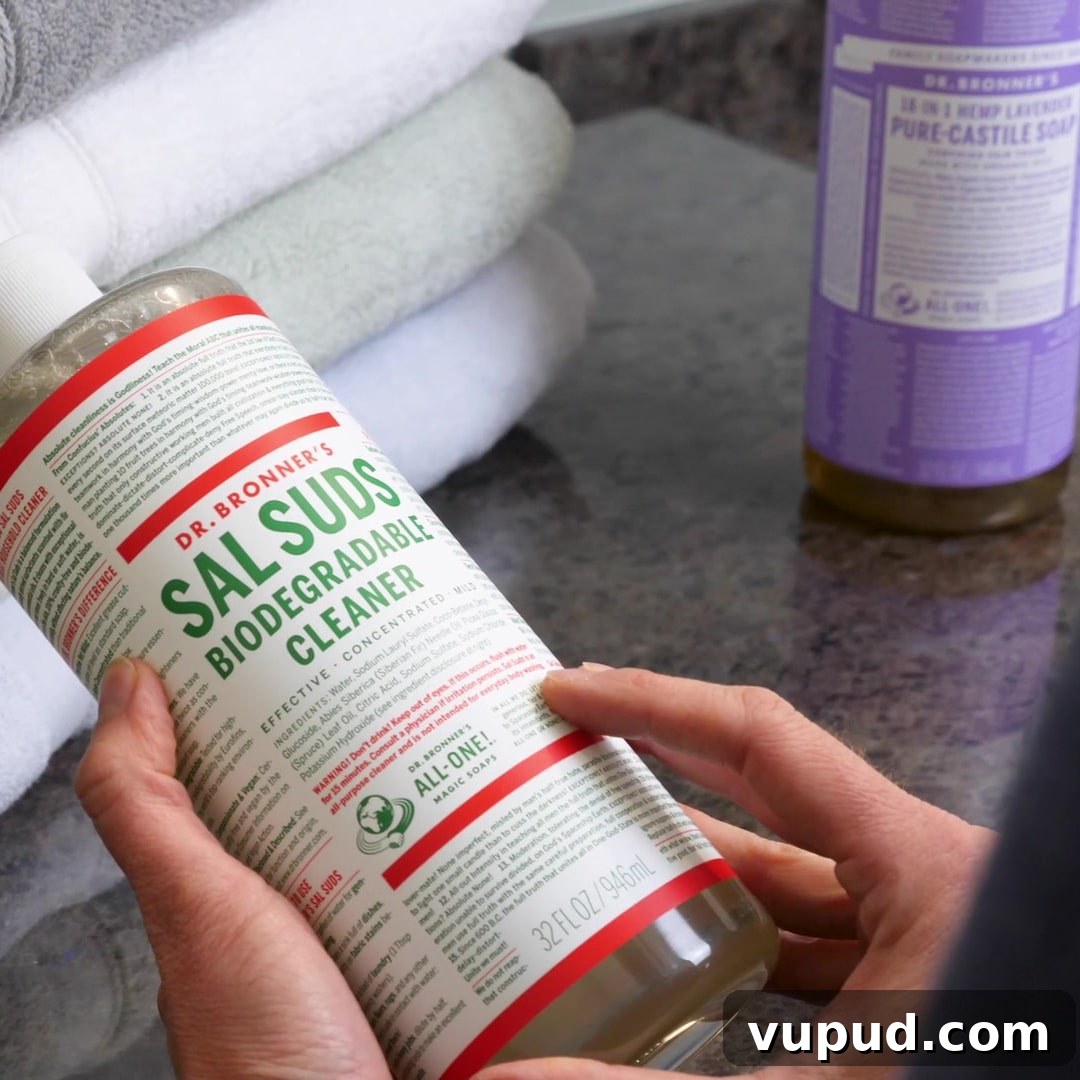
If I made a pie chart of where I use the most Sal Suds in my home, the largest slice would be laundry. That’s not because I use much per load, but because I do a lot of loads: five people, two cats, one dog, and plenty of dirt.
My laundry cabinet holds both Sal Suds and Dr. Bronner’s Castile Magic Soap, but I reach for Sal Suds more often because it’s tougher on stains and performs better in our hard water. I didn’t choose it because of family ties, but after learning about problematic ingredients in many cleaning products, I realized residues left on fabric stay in contact with skin for long periods. That adds up to substantial exposure. I wanted cleaners that left laundry truly clean, and both Pure-Castile Magic Soap and Sal Suds meet that need.
Table of contents:
- My laundry regimen
- Then comes the drying
- Dr. Bronner’s in HE washing machines
- The three foundational pillars of my house
My laundry regimen
It’s pretty simple. For clothing in a high-efficiency (HE) washer, I use about 1 to 1½ tablespoons (15–22 mL) of Sal Suds, or 3–4 tablespoons (45–60 mL) of Pure-Castile Magic Soap for a large load. In standard washers, double those amounts.
When washing heavier loads like towels, I sometimes add 1/4 cup (70 g) of baking soda. Because we have hard water, with the Castile Magic Soap I’ll add 1/2 cup (120 mL) of vinegar to the rinse via the fabric softener compartment. Again, double these amounts for standard machines. Both Sal Suds and Castile Magic Soap biodegrade readily and are safe for septic and greywater systems.
For ketchup, grass, or last-night’s-dinner stains, I pre-treat by dabbing a small amount of Sal Suds directly on the spot before washing. For general stains I use a 1:1 dilution of water to Sal Suds; for lighter problems like a collar ring I spray with a gentle Sal Suds all-purpose solution.
That’s it. Simple works: my laundry comes clean, colors stay vibrant, and clothes don’t wear out prematurely. I’m fine with that.
Then comes the drying
Drying is probably the harshest thing we do to clothes. The dryer shortens fabric lifespan and consumes a lot of energy. Air-drying is gentler on garments, lowers energy bills, and is better for the environment. Whenever possible, we hang items to dry in sunlight and fresh air, which also helps refresh fabrics without extra chemicals.
Dr. Bronner’s in HE washing machines
Many customers and colleagues have told me Dr. Bronner’s Magic Soap and Sal Suds work well in HE machines. We now have third-party testing that confirms their suitability for HE washers, which use less water and require low-foam detergents.
Testing showed these products meet criteria for “acceptable HE detergent” when used at recommended dilutions: 1 tablespoon (15 mL) Sal Suds or 2–3 tablespoons (30–45 mL) Magic Soap for a large load. Test parameters included:
- Suds must not fill the machine window past one-third at any time.
- Average cycle time cannot exceed the estimated cycle time by more than 15 minutes, which would indicate excess suds triggering longer rinses.
- The machine must not initiate a “suds lock” error, which signals an abundance of suds.
- To pass, the test is repeated four times and must meet the criteria each time.
The three foundational pillars of my house
I’ve come to see bed, laundry, and dishes as the three foundational pillars that shape my home life. These tasks govern daily order, productivity, and my peace of mind. Facing a long list of undone chores can be paralyzing; I’m the kind of person who sees the value in many possibilities. Having a straightforward starting routine — make the bed, start the laundry, load the dishwasher — gives me momentum.
If I do those three things, the rest of the day tends to fall into place. If I neglect them and focus elsewhere, the house still feels undone at day’s end, no matter what I accomplish. I’m past the days when life felt like a giant pile of dirty laundry with kids sliding down it. I don’t mind doing laundry, but I’d rather spend time with the children than sorting socks.
Further reading
- Pretreating Laundry Stains
- Sunshine & Sachets: Best Ways to Dry Clothes
- Why (& How) to Ditch Fabric Softener and Dryer Sheets
- Washing Cloth Diapers with Sal Suds & Sunshine
This use and many more are explored in my book, Soap & Soul: A Practical Guide to Minding Your Home, Your Body, and Your Spirit with Dr. Bronner’s Magic Soaps, available in hardback, eBook, and audiobook.
Sal Suds cleaner shows >60% biodegradation after 28 days per ISO 14593.